On this page
Quick takeaway
Learn how TMT bars achieve strength and ductility through hot rolling, quenching, self-tempering and cooling. Understand the complete TMT manufacturing process.
Most people assume a TMT bar is just a steel rod that got rolled into shape and left to cool somewhere. That's not really what happens. On the mill floor there's an exact sequence of heating, cooling, and reheating going on, and that sequence is basically the whole reason a TMT bar can be strong enough to carry load and still flexible enough to bend instead of snapping.
Miss a step, or get the timing off even slightly, and you end up with a bar that's strong but brittle, or one that bends fine but can't carry much weight. Neither version belongs in a building.
TMT stands for Thermo-Mechanically Treated, which is really just a description of what happens to the steel — heat, mechanical shaping, and heat treatment, done in that order.
Once you understand what each stage is doing, it explains a lot about why the bar behaves the way it does once it's sitting in concrete for the next fifty years.
Quick Answer: How Are TMT Bars Made?
TMT bars are manufactured by heating steel billets, rolling them into ribbed reinforcement bars, rapidly cooling the outer surface through water quenching, allowing the hot core to self-temper the hardened surface, and finally cooling the bars naturally on a cooling bed.
This controlled thermal process creates:
- a strong tempered outer layer
- a more ductile inner core
- good strength
- better elongation
- the ability to absorb stress without sudden brittle failure
The balance between the outer layer and inner core is one of the main reasons TMT bars can provide both strength and ductility.
TMT Bar Manufacturing Process at a Glance
The manufacturing process can be understood in six basic stages:
- Steel billet preparation
- Reheating
- Hot rolling
- Rapid water quenching
- Self-tempering
- Atmospheric cooling
Each stage influences the final mechanical properties of the reinforcement bar.
It starts with the raw material
Before rolling even begins, the chemistry has to be right. TMT bars come from billets — solid blocks of steel — made either through the blast furnace route or through the Electric Arc Furnace (EAF) route, which uses premium recycled steel and is becoming more common.
Carbon content matters a lot here, along with controlled amounts of manganese and silicon, and sometimes micro-alloying elements like copper, chromium and nickel.
Push carbon too high and the bar turns brittle no matter what happens afterward in the process. Keep it too low and you simply don't get enough strength.
That's why the composition gets tested and corrected before rolling starts, not somewhere down the line when it's harder to fix.
Hot rolling shapes the bar
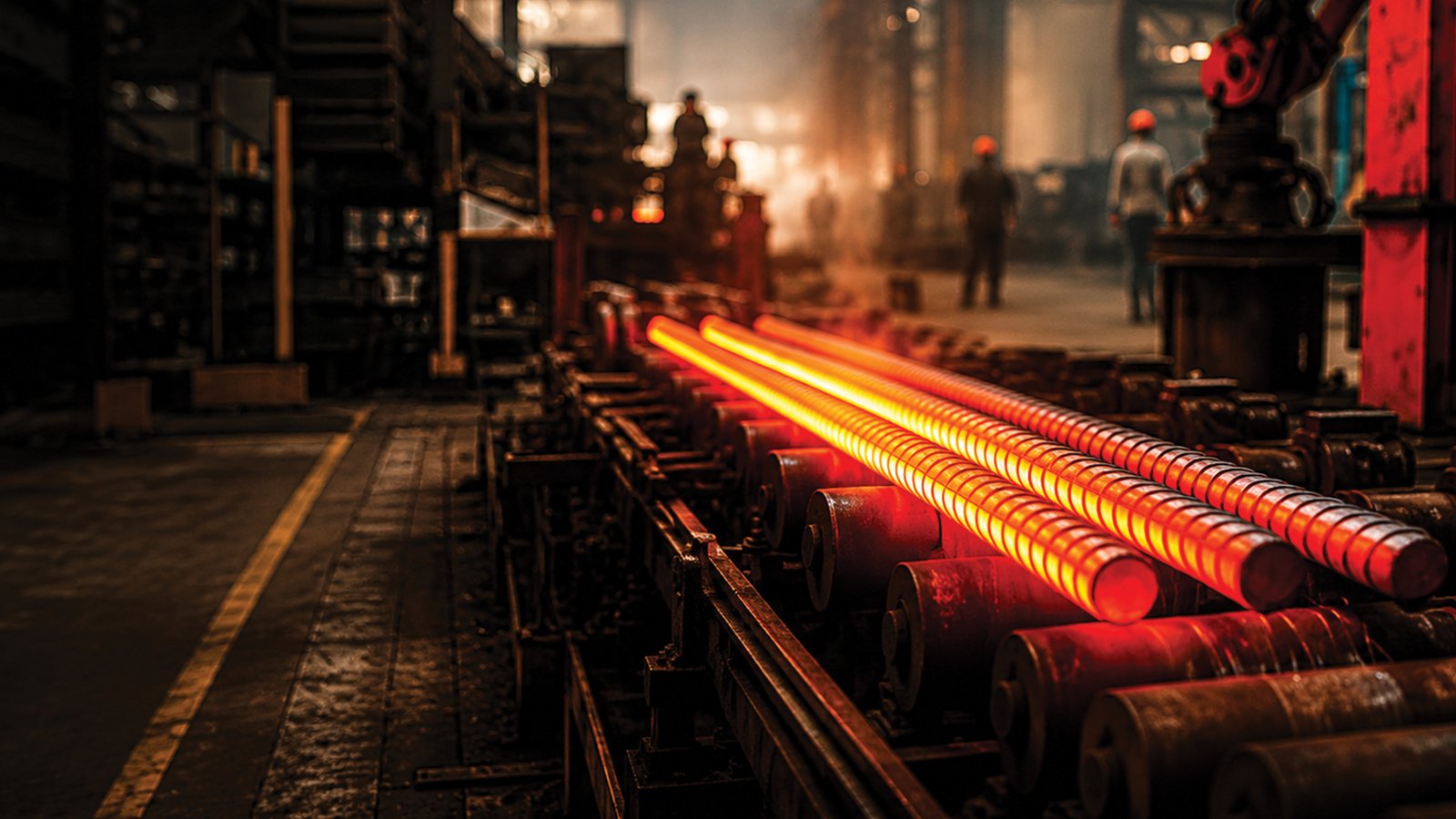
The billet goes back into a furnace and gets reheated to a high temperature, well above 1000°C, until it's soft enough to work with.
From there it passes through a series of rolling mills that gradually bring down the diameter and form the ribbed pattern you see on the surface.
Those ribs aren't there for looks. They help the bar grip the surrounding concrete better, and that bond matters a lot more to how the structure performs than most people give it credit for.
By the time hot rolling is done, the bar has the right shape and size, but internally it's still pretty uniform — nothing special has happened to it yet metallurgically.
That comes next.
Why Do TMT Bars Have Ribs?
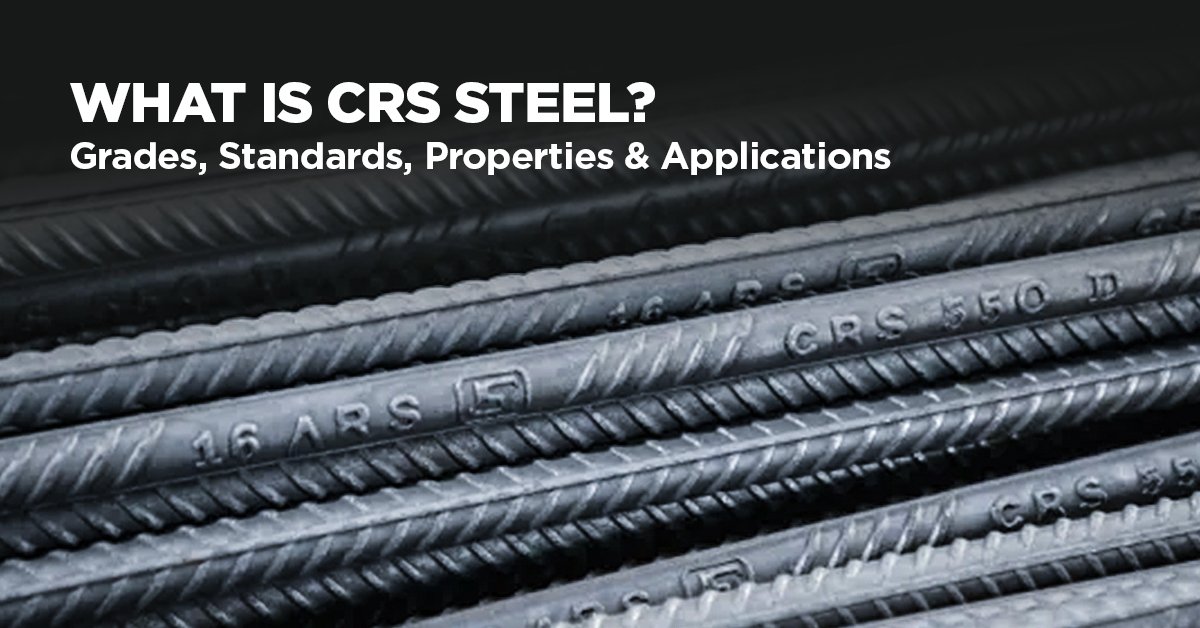
The raised rib pattern on a TMT bar improves its mechanical bond with the surrounding concrete.
Concrete performs very well under compression, while steel reinforcement helps carry tensile forces.
For reinforced concrete to behave as one structural system, the steel needs a reliable bond with the concrete around it.
The ribbed surface helps improve this interaction and limits unwanted movement between the reinforcing bar and concrete.
Quenching creates the hard outer layer
Right as the bar comes out of the last rolling stand, still glowing, it runs through a water-cooling system called a quenching box.
This step is really what defines TMT steel as TMT steel.
Water hits the surface and cools it fast, but the core stays hot underneath because the water simply doesn't have time to reach that deep before the bar has moved past.
That quick surface cooling turns the outer layer into martensite, a hard and high-strength structure.
On its own, though, martensite is also brittle, and that's exactly why the process doesn't end at this stage.
What Is Quenching in TMT Bar Manufacturing?
Quenching is the rapid cooling of a hot-rolled reinforcement bar immediately after it exits the final rolling stand.
High-pressure water rapidly cools the outer surface while the inner core remains much hotter.
This temperature difference allows the surface and core to develop different metallurgical characteristics.
The outer portion gains high strength, while retained heat in the inner core becomes important during the next stage: self-tempering.
Self-tempering does the balancing act
Once the bar's out of the quenching box, the core is still carrying a lot more heat than the surface.
That heat moves outward from the core and tempers the martensite rim as it goes — softening it a little, but making it tougher in the bargain.
This step is called self-tempering, and honestly it's the part of the process that's easiest to underappreciate, because there's no separate machine doing it.
It just happens, using heat the bar already has.
What comes out the other end is a rim that's hard, but not brittle in the way raw martensite would be.
What Is Self-Tempering in TMT Bars?
Self-tempering is the stage where heat retained inside the hotter core moves toward the rapidly cooled outer surface.
This residual heat tempers the hard martensitic surface layer.
The process helps the outer layer retain its high strength while becoming tougher and less brittle.
This is a crucial stage in developing the strength-and-ductility balance associated with TMT reinforcement.
Atmospheric cooling finishes the job
After that, the bar goes onto a cooling bed and is left to cool down slowly in open air.
The core, which never fully turned into martensite in the first place, settles into a softer structure called ferrite-pearlite during this stage.
So by the time it's fully cooled, you've got a bar with two different zones doing two different jobs — a tough, tempered rim on the outside, and a softer, more ductile core running through the middle.
TMT Bar Microstructure: Strong Outside, Ductile Inside
One of the defining characteristics of a properly processed TMT bar is the difference between the outer region and inner core.
Outer Layer
The rapidly cooled outer region develops a high-strength structure.
After self-tempering, the surface combines strength with toughness.
Inner Core
The core cools more gradually and develops a ferrite-pearlite structure.
This inner region contributes significantly to:
- ductility
- elongation
- bendability
- energy absorption
This difference across the bar's cross-section is what allows TMT reinforcement to provide both structural strength and flexibility.
Why the two-zone structure matters
This is really the part that explains everything else, so it's worth spending a bit more time on.
The outer rim is what gives the bar its strength and its ability to resist deformation under normal structural loads.
The core is what gives it ductility — the ability to bend, absorb a sudden jolt, and deform gradually rather than snap outright.
During an earthquake, or really any sudden load event, it's that ductile core doing the work of letting the bar yield and absorb energy instead of just fracturing.
This is also the reason grades like Fe 500D and Fe 550D exist separately from Fe 500 and Fe 550 — the "D" specifically points to elongation and ductility, and getting there means tighter control over that rim-to-core ratio during production.
Get the quenching time or the water pressure wrong and this balance shifts one way or the other.
Quench too aggressively and there's not enough residual core heat left to temper the rim properly, so it stays brittle.
Quench too lightly and the martensite layer never really forms, so you lose strength.
A mill that consistently produces good TMT bars isn't just running steel through rollers — it's controlling this thermal balance batch after batch, day after day, which is also why batch-level testing and spectro-analysis matter a lot more than people assume.
How TMT Bars Achieve Both Strength and Ductility
Strength and ductility may appear to be opposite properties.
A very hard material can sometimes become brittle, while an extremely flexible material may not provide enough structural strength.
The thermo-mechanical treatment process is designed to balance these characteristics.
The outer zone primarily contributes strength, while the inner core contributes ductility and elongation.
The final performance therefore depends heavily on precise control of:
- rolling temperature
- quenching duration
- water pressure
- cooling rate
- steel chemistry
- core temperature
- tempering conditions
Small variations in these parameters can affect the final mechanical properties of the reinforcement bar.
Why Process Control Matters in TMT Manufacturing
TMT manufacturing is not simply a matter of heating steel and spraying it with water.
Process consistency matters throughout production.
Important controls include:
Rolling Temperature
The steel must be maintained within appropriate temperature ranges during rolling.
Water Pressure
Quenching water must cool the surface at a controlled rate.
Quenching Duration
Too much or too little cooling can change the final microstructure.
Chemical Composition
The underlying steel chemistry affects strength, ductility, weldability and the way the steel responds to heat treatment.
Batch Testing
Mechanical and chemical testing helps manufacturers verify that production batches meet required specifications.
A high-quality manufacturing process is therefore based on repeatability and control, not simply the presence of a quenching system.
Chemistry still plays its part
The thermo-mechanical process does most of the work, but the base chemistry decides how much that process actually has to work with.
Micro-alloying elements — chromium, copper, molybdenum, nickel, in carefully controlled amounts — improve things like corrosion resistance and let manufacturers fine-tune strength without giving up ductility in the process.
This matters particularly for steel going into high-salinity environments, where corrosion resistance needs to be built in from the composition stage.
Adding it as an afterthought later doesn't really work.
Why Carbon Content Matters in TMT Bars
Carbon plays an important role in determining the behaviour of reinforcement steel.
Increasing carbon content can increase strength, but excessive carbon can reduce ductility and influence weldability.
Manufacturers therefore have to control carbon along with elements such as manganese, silicon, sulphur and phosphorus.
The desired properties of the final TMT bar depend on both:
Steel chemistry + Thermo-mechanical treatment
Neither should be considered independently.
Why Manufacturing Quality Matters for Fe 500D and Fe 550D
Grades such as Fe 500D and Fe 550D are designed to offer higher levels of ductility alongside specified strength.
Producing these grades consistently requires tight control over manufacturing variables and final mechanical properties.
The letter D is associated with enhanced ductility requirements.
That means simply achieving the target strength is not enough.
The bar must also meet the applicable requirements for elongation and other mechanical properties.
This makes manufacturing consistency, testing and quality control particularly important for ductile TMT grades.
TMT Bar Manufacturing Process and Earthquake Resistance
Ductility becomes especially important when reinforcement is subjected to sudden or cyclic loading.
During seismic activity, structural members may experience repeated movement and stress reversals.
Steel reinforcement that can deform and absorb energy without sudden brittle failure is therefore important in earthquake-resistant structural design.
However, earthquake resistance does not depend only on the steel manufacturing process.
It also depends on:
- structural design
- reinforcement detailing
- concrete strength
- foundations
- workmanship
- seismic code compliance
- correct grade selection
TMT reinforcement is one component of the complete structural system.
Why any of this matters if you're not a metallurgist
You don't need to understand martensite transformation to build a house, and nobody's expecting you to.
But it's useful to know that "TMT bar" isn't just a generic label slapped on any steel rod — it describes a specific manufacturing discipline, and how well that discipline is followed is what separates a bar that performs the way it's supposed to from one that quietly doesn't.
So the next time a mill talks about controlled quenching or consistent rolling temperatures or batch testing, at least now you know what they're actually referring to.
FAQs
What does TMT stand for in TMT bars?
TMT stands for Thermo-Mechanically Treated.
It refers to the process of hot rolling followed by rapid water quenching and self-tempering, which gives the bar its combination of strength and ductility.
How do TMT bars get both strength and flexibility?
The manufacturing process creates two distinct zones in the bar — a hard, tempered martensite outer rim that provides strength, and a softer ferrite-pearlite core that provides ductility.
Together, they let the bar resist load while still being able to bend under sudden stress.
What is quenching in TMT bar manufacturing?
Quenching is the rapid water-cooling of a hot-rolled steel bar right after it exits the rolling mill.
It hardens the outer surface of the bar while the core remains hot, setting up the strength-ductility balance that defines TMT steel.
Does the chemical composition of steel affect TMT bar quality?
Yes.
Carbon content and micro-alloying elements like chromium, copper, and nickel influence how the steel responds to thermal treatment, as well as properties like corrosion resistance.
Both the process and the underlying chemistry need to be right for the bar to perform as intended.
Why is the "D" grade more ductile than regular TMT bars?
D-grade bars, like Fe 500D and Fe 550D, are manufactured with tighter control over the rim-to-core ratio and elongation properties during the thermo-mechanical process, which gives them measurably higher ductility than their non-D counterparts.
What are the main stages of TMT bar manufacturing?
The primary stages include steel billet preparation, reheating, hot rolling, rapid water quenching, self-tempering and atmospheric cooling.
What is martensite in a TMT bar?
Martensite is a hard steel microstructure formed in the outer region of the bar during rapid cooling.
The subsequent self-tempering stage makes this surface tougher while retaining high strength.
What is ferrite-pearlite in TMT bars?
Ferrite-pearlite is the softer and more ductile structure that develops primarily in the inner core as the bar cools more gradually.
It contributes to elongation and ductility.
Why is water pressure important during TMT quenching?
Water pressure affects how quickly and deeply the bar surface cools.
Incorrect quenching conditions can disturb the balance between the hardened outer region and the hotter inner core.
Are all TMT bars manufactured the same way?
The basic thermo-mechanical principles are similar, but manufacturing technology, process control, raw-material chemistry, testing standards and quality-control systems can differ between manufacturers.
Why do TMT bars have ribs?
The ribs improve the bond between reinforcement steel and surrounding concrete, helping the two materials work together more effectively in reinforced concrete structures.
Does higher strength automatically mean better TMT steel?
Not necessarily.
Structural performance depends on several properties including strength, ductility, elongation, chemistry, manufacturing consistency and compliance with the required grade specification.
Next step
Review ARS quality, testing, and manufacturing proof.
See how ARS supports strength, consistency, and buyer confidence from plant to project site.